

 By
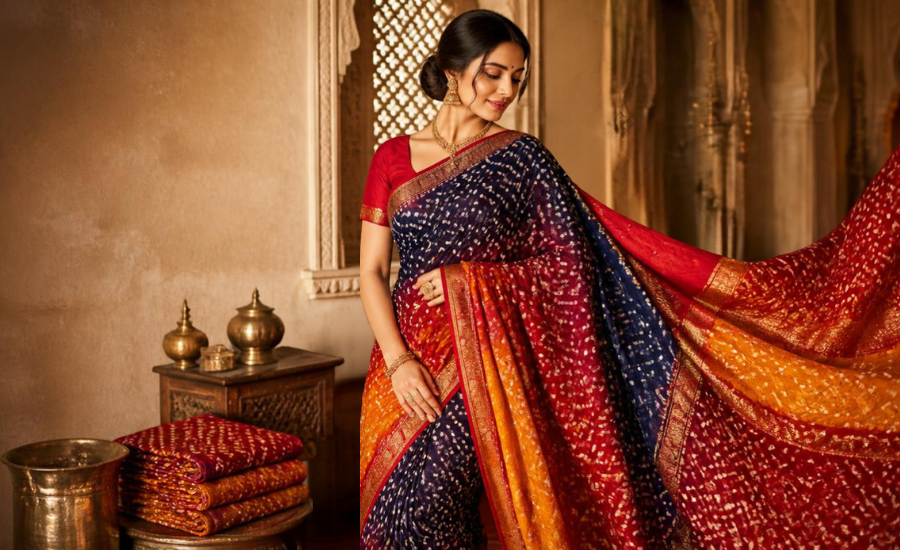
By Few Indian textiles capture colour, tradition, and craftsmanship quite like a Bandhani saree. Recognised for its vibrant hues and delicate dotted patterns, Bandhani is one of India’s most celebrated tie-dye traditions. From royal celebrations to modern festive wardrobes, this age-old craft has continued to evolve while preserving its distinctive identity.
But behind every tiny dot is a story of patience, skill, and generations of textile artistry.
What Makes Bandhani Special?
The word Bandhani comes from the Sanskrit word bandh, meaning “to tie.” The name perfectly describes the technique used to create these beautiful textiles.
In traditional Bandhani, artisans carefully pinch tiny portions of fabric and tightly tie them with thread. The fabric is then dipped into dyes. The tied sections resist the colour, creating the characteristic circular dots and patterns.
Depending on how the fabric is tied and dyed, artisans can create intricate designs ranging from small dotted patterns to elaborate floral, geometric, and symbolic motifs.
What may look like a simple dot from a distance is actually the result of meticulous handwork.
A Tradition Rooted in Royal Heritage
Bandhani has strong cultural associations with western India, particularly Gujarat and Rajasthan. Over generations, the craft became closely connected with traditional celebrations, weddings, and royal wardrobes.
Certain Bandhani patterns and colour combinations have also carried cultural significance. Red, for example, has traditionally been associated with weddings and auspicious occasions, while bright yellows, greens, and pinks are commonly seen in festive designs.
The craft’s connection with celebrations has helped Bandhani remain an important part of India’s textile heritage.
The Making of a Bandhani Saree
Creating authentic Bandhani is a highly skilled process.
The artisan begins with a suitable fabric, often silk, cotton, or other lightweight textiles. Small sections are then carefully pulled and tied using thread. Depending on the desired pattern, thousands of tiny ties may be created across the fabric.
The saree is subsequently dyed, sometimes in multiple stages to achieve layered colours. After the dyeing process, the knots are opened to reveal the distinctive patterns.
The result is a fabric filled with tiny variations and beautifully irregular details—one of the characteristics that makes handcrafted Bandhani so appealing.
Bandhani vs. Other Indian Sarees
India’s saree traditions are remarkably diverse. A Patola saree, for instance, is famous for its intricate double-ikat weaving, where both warp and weft threads are resist-dyed before weaving. A Banarasi saree is celebrated for luxurious silk, brocade patterns, and zari work.
Bandhani stands apart through its tie-dye technique.
Rather than relying primarily on woven motifs or metallic embellishments, Bandhani creates its visual identity through carefully tied and dyed sections of fabric. Its vibrant colours and distinctive dotted patterns make it instantly recognisable.
From Traditional Wardrobes to Modern Fashion
While Bandhani remains deeply connected to Indian traditions, its appeal has extended well beyond conventional festive wear.
Today, Bandhani-inspired designs can be found on sarees, dupattas, lehengas, scarves, and contemporary outfits. Designers frequently experiment with colour combinations, fabrics, and pattern placement while retaining the essence of the traditional craft.
A Bandhani saree can therefore feel both timeless and contemporary—especially when styled with modern jewellery, minimalist blouses, or contemporary accessories.
Why Bandhani Continues to Endure
The beauty of Bandhani lies in its simplicity and complexity at the same time. Its signature dots may appear delicate and effortless, but creating them requires remarkable patience and precision.
Each knot represents a small act of craftsmanship. When thousands of these knots come together, they create a textile that reflects India’s long-standing love for colour, celebration, and handmade artistry.
More than a fashion statement, a Bandhani saree is a celebration of an enduring Indian craft tradition. Its vibrant colours, distinctive patterns, and handcrafted character ensure that this timeless tie-dye legacy continues to find a place in wardrobes across generations.